
ElevenLabs Music Audio Quality: Clean Stems, Sibilance, and Edit Transitions
A practical ElevenMusic v2.5 cleanup guide for sharp vocals, separated-stem residue, transition seams, mono checks, and level-matched listening before mastering.
Clean my ElevenMusic export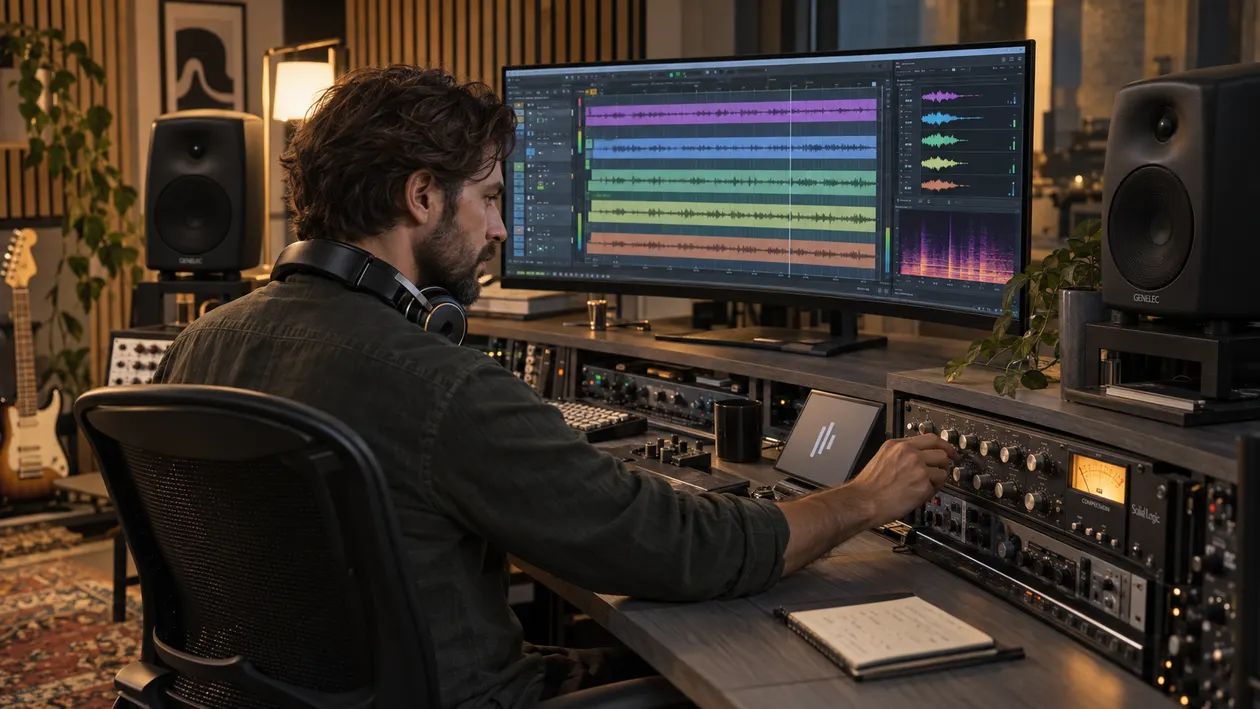
The lead vocal is clear until a fast line arrives, then every “s” seems to jump out of the speakers. The drums and bass feel solid in solo, but the low end becomes hollow when they play together. A genre change works musically, yet the reverb seems to stop at the edit. These are three different problems, so they should not receive the same processing chain.
The practical answer is to keep the best original export, identify one audible symptom at a time, and make the smallest useful change. Check separated stems in the full mix, compare in mono when the low end or stereo image feels unstable, and level-match every before-and-after decision. Cleanup comes before mastering, but it does not replace editing, mixing, or regeneration.
Checked September 20, 2026. ElevenLabs documents Music v2.5 as the current default for prompted and Audio Reference generation in ElevenMusic, while Music v2 remains available. The current product supports Audio Reference, composition plans, inpainting, and 2-, 4-, or 6-stem separation. Official documentation does not document five native output stems.
The short answer: clean the export you actually have
ElevenMusic gives you several ways to change a song before download. You can edit lyrics and sections, use inpainting to regenerate a passage, guide Music v2 or v2.5 with a short Audio Reference, and separate a finished song into stems. Those creative controls are useful, but they do not tell you whether the exported audio needs cleanup.
Listen to the file you actually downloaded. If a consonant stings only during one phrase, treat that phrase. If the vocal is comfortable but the whole chorus has a thin glassy layer, work from the full mix. If a transition changes the arrangement or timing, return to the edit rather than trying to hide it under EQ.
I usually check the busiest chorus first. That is where metallic shimmer tends to stop hiding behind the arrangement. I also keep one quiet vocal tail in the test loop, because a harsh consonant, residual drum hit, or abrupt ambience change is easier to hear when fewer sounds compete for attention.
Diagnose the audible symptom before choosing a tool
Start with a short loop around the moment that bothered you, then play the same passage in context. Keep monitoring at a comfortable level. A bright mix played louder can feel like a sibilance problem even when the real issue is comparison bias.
- Sharp sibilance: “s,” “sh,” “t,” and “ch” sounds leap forward while vowels remain acceptable. Sibilance often occupies the upper mids and highs, but there is no universal ElevenMusic frequency. Find the band in your file instead of copying a fixed preset.
- Separated-stem residue: a vocal stem contains cymbal spray or room-like ambience, or the instrumental layer carries faint vocal fragments. Stem separation estimates source groups; it does not recover pristine multitrack recordings.
- Weak mono punch: drums and bass sound wide and impressive in stereo but become smaller together in mono. That is a reason to inspect timing, polarity, stereo effects, and overlap. It is not proof that ElevenLabs generated a phase error.
- Transition seam: ambience cuts off, stereo width changes, a word begins twice, or a downbeat feels displaced at an edited section. A tiny discontinuity may respond to a crossfade. A musical mismatch needs another edit or regeneration.
- Harsh full-mix top end: cymbals, vocals, and bright instruments turn into one tiring layer. The harsh-highs guide shows why a broad treble cut can remove useful air along with the problem.
Do not decide from a soloed stem alone. Solo helps you locate a problem, but separation residue may disappear in context, and an apparently clean stem can combine badly with the other layers. Your final decision belongs in the complete song.
Source preflight: Music v2.5, downloads, and current rights
Music v2.5 launched on September 11, 2026. ElevenLabs says it is the default for prompted and reference generation, with Music v2 still available. The company also describes lossless downloads under current plan limits. Its product documentation lists MP3 and WAV availability, while plan entitlements and quality limits can change. Download the best original file your account offers and avoid converting a lossy MP3 to WAV just to change the filename.
Audio Reference can guide characteristics such as sound, mood, instrumentation, tempo, and production style. ElevenLabs says uploaded references are screened for copyright compliance and are not used as a direct remix or genre-transfer tool. That is a generation feature, not an audio-repair feature: if the new export has a harsh consonant or a messy transition, inspect the result after generation.
The September 10 agreement between Universal Music Group and ElevenLabs covers licensing, product development, and a separate future platform for participating artists and fans. The UMG agreement is separate from Music v2.5. It does not turn every ElevenMusic export into cleared UMG material, and it does not remove the need to follow the terms that apply to your plan, inputs, references, and intended use.
Commercial permissions vary by subscription and conditions. ElevenLabs’ current announcement says Free creations can be used commercially with attribution, while other rights and restrictions depend on the applicable terms. Treat the terms attached to the track as the source of truth; audio cleanup does not grant legal clearance or guarantee distributor approval.
Stem separation preflight: 2, 4, or 6 stems
ElevenLabs documents stem separation as a paid feature with 2-, 4-, or 6-stem options. The two-stem path separates vocal and instrumental. The four-stem path adds drums, bass, and an “other” group around the vocal. The six-stem path provides more detailed separation. These are separated outputs from a song, not five native recordings captured before the mix.
Import every file into a new DAW session without moving individual regions. Align every file at sample zero and keep the session sample rate consistent. Play all stems together and compare their sum with the original full mix at matched loudness. If the reconstruction changes noticeably before you add processing, document that difference before deciding a plugin caused it.
Solo the vocal and listen for consonants, breath-like hiss, percussion leakage, and reverb residue. Solo drums for splashy cymbal tails and softened attacks. Check bass with drums in mono, then return to stereo. For melody and supporting layers, listen for fragments that appear to belong to another group. Perfectly silent stems are unnecessary. The recombined mix needs to preserve the song.
Choose the smallest useful separation. Two stems are often enough when the vocal is the only problem. Four or six stems help when drums, bass, and other instruments need different decisions, but more files also create more chances to amplify leakage or change the balance.
ElevenMusic stem and transition inspection map
ElevenMusic Stem and Transition Inspection Map
| Layer or edit | What to listen for | Useful check | First restrained action |
|---|---|---|---|
| Full mix | Harsh top end, clipped peaks, tonal jump at an edit | Match loudness and loop the busiest chorus plus one quiet tail | Decide whether the problem is global or belongs to one layer |
| Vocal separation | Sibilance, metallic edge, cymbal leakage, abrupt reverb | Solo briefly, then restore the full mix | Use phrase-triggered de-essing only where consonants jump out |
| Drum separation | Splashy cymbals, softened attack, pumping ambience | Compare drum solo with the reconstructed mix | Tame one repeatable problem; avoid brightening the whole stem |
| Bass separation | Hollow sum, wandering low end, overlap with kick | Check drums plus bass in mono and stereo | Inspect alignment and effects before changing polarity or EQ |
| Other or detailed stems | Vocal fragments, smeared harmony, unstable width | Mute one layer at a time in the full mix | Leave residue alone when it is masked and harmless |
| Inpainted or genre-transition boundary | Click, doubled attack, cut reverb, timing or timbre jump | Loop before and after the boundary, then play the whole section | Crossfade a discontinuity; regenerate a musical mismatch |
The table deliberately contains no universal bleed percentage or phase score. I cannot supply a factual bleed percentage or phase-correlation rating without measuring your exported files. Separation quality depends on the song, the selected option, the material inside each layer, and the way you recombine it.
Restrained manual cleanup in your DAW
For vocal sibilance, begin with a dynamic de-esser: it turns down the problem band only when a sharp consonant crosses the threshold. Use split-band mode if the rest of the vocal should stay untouched. Sweep while the difficult phrase loops, then lower the range until the consonant sits inside the word instead of leading it. If the singer starts to lisp or the lyric loses clarity, reduce the processing.
Do not assume 7.2 kHz is correct because it appears in a tutorial. Many voices place the strongest sibilance somewhere across a wider upper-frequency region, and the exact spot changes with the vowel, consonant, arrangement, and export. The AI vocal guide explains how to separate sharp consonants from a broader plastic or metallic vocal tone.
For percussion, use transient shaping only when the attack itself clicks or feels unnaturally hard. Pulling every transient down can remove the groove. If cymbals sound like spray, try a small dynamic high-frequency reduction during the worst hits and stop when the cymbal keeps its shape.
High-pass filtering can clear sub-rumble from a vocal or bright supporting stem, but a fixed 90 Hz filter is not safe for every part. Raise the cutoff while listening to the full mix, then back down as soon as the source loses body. Linear-phase filtering can create pre-ringing around sharp events, so use it only when the audible result beats a simpler minimum-phase filter.
At an edit boundary, zoom in before reaching for full-track processing. A short crossfade can hide a click or reconnect a reverb tail. Gain automation can smooth a level jump. If the new section changes timing, words, instrumentation, or performance, return to ElevenMusic inpainting or rebuild the transition in the arrangement.
The Sunofix path for ElevenLabs Music exports
Manual tools work well when the problem is stable and easy to name. They become risky when the synthetic edge moves between vocal peaks, cymbal tails, and dense transitions. Several broad cuts can make the entire song dull while leaving the moving artifact partly intact.
I built Sunofix for this exact stage: the song already works, but the exported mix still has a synthetic edge. Start with the full mix when the problem moves through the arrangement. If one separated vocal or melodic layer clearly carries the defect, you can test that file separately, then return it to the DAW and rebuild the mix at the original timing and gain.
Compare the raw and processed versions at matched perceived loudness. Use the same chorus, the same quiet tail, and the same transition boundary. The cleaner version should reduce the distraction without changing the melody, lyrics, arrangement, performance, or emotional center of the song.
Sunofix is track-aware cleanup, not stem balancing. It can reduce harsh or metallic texture in the file you upload and provide before-and-after diagnostics. It cannot set the relative level of your vocal, drums, and bass, and it cannot fix polarity or timing between separate stems. The broader AI music cleanup workflow shows where cleanup ends and mixing or mastering begins.
Editorial boundaries and technical limits
Cleanup cannot rewrite lyrics, repair an arrangement jump, or recover audio lost to clipping or lossy encoding. If a genre transition changes the groove, a syllable is wrong, or the new passage uses incompatible instrumentation, choose another inpainting result or edit the arrangement. If an MP3 discarded detail, saving it as WAV will not restore the missing information.
De-essing can reduce an overactive consonant; it cannot change pronunciation or vocal performance. EQ can soften a repeatable resonance; it cannot reconstruct a clean source hidden inside separation residue. A polarity flip may improve one bass-and-drum combination and damage another, so compare the whole section rather than treating it as a universal phase fix.
Stop when the defect no longer distracts you in context. If the vocal becomes dull, cymbals lose their edge, the low end weakens, or a transition attracts more attention after processing, back off. Preserving the chosen song matters more than making every stem look clean on a meter.
ElevenLabs and ElevenMusic are not affiliated with Sunofix. Product features, plans, download limits, and terms can change, so verify the current controls in your account. Sunofix improves audio quality; it does not grant legal clearance or guarantee distributor approval.
ElevenMusic release checklist
- Export the best available full mix and preserve an untouched copy.
- Choose 2, 4, or 6 stems only when isolation helps you name a specific problem.
- Align every file at sample zero and compare the reconstructed mix with the original.
- De-ess the vocal only when the consonants trigger the problem, then stop before clarity turns into a lisp.
- Check transition boundaries in context and use editing or regeneration for musical mismatches.
- Level-match the final A/B across the busiest chorus, one quiet tail, and every edited seam.
- Keep headroom for mastering instead of forcing the cleanup render into another limiter.
If the vocal sits naturally, the low end holds together in mono, and the transition passes without pulling your attention away from the song, you have a useful source for the next stage. That next step may be mixing, mastering, another edit, or no further processing at all.
Continue listening
Related reading
FAQ
ElevenLabs Music Audio Quality: Clean Stems, Sibilance, and Edit Transitions FAQ
Does Sunofix support ElevenLabs Music stems?
Yes. You can upload a lawful vocal, instrumental, separated stem, or full-mix audio file in a format Sunofix accepts. Clean only the layer with the audible problem, then judge it again inside the complete mix.
Why can an ElevenMusic vocal sound sharp on consonants?
A generated vocal can place a lot of short high-frequency energy on s, sh, t, and similar sounds. That audible result is sibilance, but it does not prove a specific cause inside the private ElevenLabs model. Confirm it at matched loudness before de-essing.
Can cleanup fix a jump when a song changes genre mid-track?
Cleanup may soften a harsh tonal change or an exposed reverb tail, but it cannot repair a musical mismatch in timing, instrumentation, lyrics, or performance. Use a local edit, crossfade, or another inpainting pass when the arrangement itself jumps.
Should I clean the full mix or each stem separately?
Start with the full mix. Move to stems only when you can identify one problem layer and recombine the files without changing their timing. Processing every separated stem can pull residue forward and create more work than it solves.