
Stable Audio 3.0 Audio Quality: Clean Long-Form Haze and Inpainting Seams
A practical guide to checking Stable Audio 3.0 renders for long-form tonal drift, audible haze, edit-boundary seams, and low-end rumble before mastering.
Clean my Stable Audio export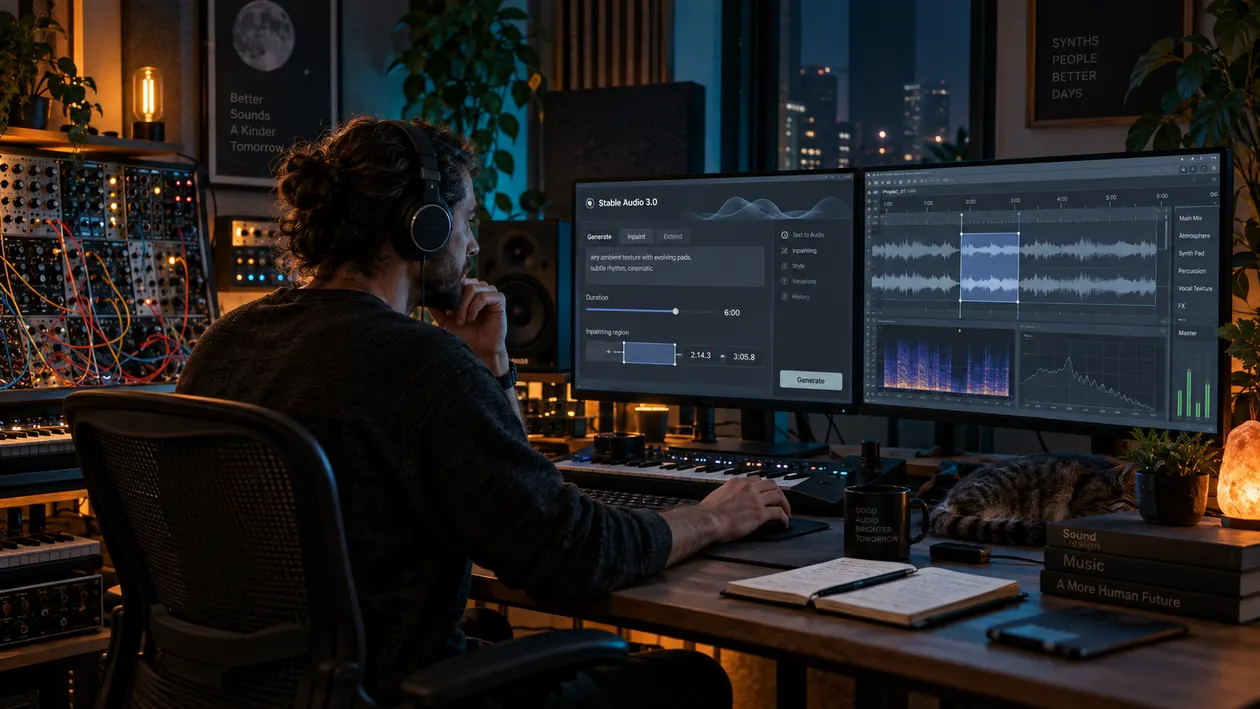
A six-minute AI-generated track gives you more music to work with, but it also gives small problems more time to become distracting. A quiet sandy layer may appear only in the intro. The low end may feel steady for two minutes and then begin to wander. A regenerated section can be musically right while the join produces a tiny click or a sudden change in ambience.
Do not assume those sounds are built into every Stable Audio 3.0 render. Start with the file in front of you. Mark the exact moment that pulls your attention away from the song, compare it at matched loudness, and decide whether the problem belongs to cleanup, editing, mixing, or regeneration.
Checked September 20, 2026. Stability AI released Stable Audio 3.0 on May 20, 2026. Its official launch describes a family of Small SFX, Small, Medium, and Large models. Small SFX, Small, and Medium have open weights; Large is available through the Stability AI API and enterprise self-hosting. Medium can generate up to 6:20, while Small can generate up to two minutes. The family supports LoRA customization, single- and multi-segment inpainting, and continuation.
The short answer: inspect the export, not the model name
Stable Audio 3.0 uses a latent diffusion architecture, but “diffusion” is not a diagnosis. If you hear hiss, flutter, a click, or a dull transition, first prove that the sound is repeatable at the same timestamp. Then compare a quiet passage, a dense passage, and any edited boundary. The official documentation does not document a universal high-frequency noise floor that rises across every long render.
The smallest useful fix depends on the symptom. A single click may need a short crossfade. Sub-bass that consumes headroom may need a cautious high-pass filter. A moving glassy layer through cymbals and reverb may be a candidate for track-aware cleanup. A wrong note, a weak transition, or a change in musical direction belongs back in the generation or edit stage.
I usually listen to the first exposed section before opening a spectrum analyzer. If the texture sounds intentional in context, a bright line or broad cloud on a graph is not a reason to remove it. The display becomes useful only after your ears have identified a moment worth checking.
For a broader symptom guide, use AI music artifacts explained to separate hiss, shimmer, clipping, and reverb smear. That distinction prevents one aggressive preset from becoming the answer to four different problems.
Identify the artifact profile in your Stable Audio render
Long-form listening is easier when you divide the track into specific checks instead of playing six minutes and waiting for something to feel wrong.
- Quiet-section grain: Loop an intro, breakdown, or tail. A sand-like layer that moves with the music is different from steady room noise or deliberate tape hiss. Lower the monitor level and check whether it remains distracting inside the arrangement.
- Boundary click or ambience jump: Listen a second before and after every inpainted region. A click can come from an abrupt waveform change. A room-tone or reverb change is a larger continuity problem and may need a better regeneration.
- Low-frequency drift: Watch the spectrum below roughly 35 Hz while listening to the kick and bass. Energy that appears on a graph but does not steal headroom or trigger a limiter may not need correction.
- Tonal change over time: Compare similar sections near the beginning, middle, and end. A darker final chorus may be an arrangement choice. It becomes a cleanup issue only when an unwanted texture changes while the intended material stays comparable.
- Transient softening: Check whether drums and plucks still have a clear front edge. Do not confuse a deliberately soft performance with damage. Compare the hit in the full mix, not only in solo.
A spectrogram can show where high-frequency energy changes, but it cannot label the cause. The WAV, MP3, and FLAC spectrogram guide also shows why a later lossy export can alter the picture. Seeing haze above 14 kHz does not prove that Stable Audio caused it.
Source preflight: model, duration, format, and rights
Write down which Stable Audio 3.0 model and workflow produced the file. Small, Medium, and Large have different deployment paths and duration limits. A hosted API result, a local Medium render, an optimized runtime, and a file edited in another application should not be treated as one identical source.
The official Medium configuration uses 44.1 kHz stereo audio. Stability AI’s open repository examples save WAV files, while optimized runtimes document 16-bit PCM WAV output. That does not prove that every partner interface or hosted product exposes the same download options. Check the actual file with your DAW or a media inspector rather than assuming 24-bit WAV, MP3, FLAC, or stems are available everywhere.
Preserve the original WAV or the best original file your workflow produced. Duplicate it before editing, and keep a short note with the model, prompt, seed when available, duration, inpaint ranges, and later processing. If your source is lossy, do not convert it to WAV and describe it as lossless.
Rights need their own check. Stability AI says the open-weight models are trained on licensed data and places Stable Audio 3.0 under its Community License. Its current license page distinguishes creators and organizations under $1 million in annual revenue from enterprise use above that threshold. Those terms can change and do not clear every input, voice, sample, trademark, or third-party right. Review the current license and the terms of the exact service you used.
Inpainting seams and long-form consistency: what you can verify
Stable Audio 3.0 officially supports single-segment editing, multi-segment editing, and continuation. Inpainting regenerates a selected region while preserving material outside the mask. That is a powerful edit, but the existence of the feature does not mean every join contains a defect.
Mark every inpaint boundary in your DAW. Start playback at least one bar before the join and continue one bar after it. Listen for three separate things: a sample-level click, a sudden change in background texture, and a musical discontinuity in pitch, rhythm, or ambience.
A sample-level click can sometimes be solved with a very short fade or crossfade. Zoom in and place the edit near a zero crossing, where the waveform passes through its center line, if that does not disturb timing. Keep the fade short enough that it does not soften a drum attack.
If the background texture changes, try a slightly longer crossfade while listening in context. If you can hear the blend as a dip or wash, stop. Regenerating a wider region with more useful musical context is usually cleaner than hiding a poor join under reverb.
If the harmony, rhythm, instrumentation, or performance changes awkwardly, cleanup is the wrong tool. Return to the inpaint mask, prompt, seed, or source edit. A clean transition is not only click-free; it also makes musical sense.
Stable Audio 3.0 long-form inspection map
Stable Audio 3.0 Long-Form Inspection Map
| What you hear | What to inspect | Smallest useful action | Stop condition |
|---|---|---|---|
| Sandy texture in quiet tails | Compare the same tail at matched loudness and view its spectrum | Try a cautious cleanup pass or narrow dynamic control | Stop if reverb air and cymbal detail begin to disappear |
| Click at an inpaint edge | Zoom into both mask boundaries and check waveform continuity | Add a short fade or crossfade | Stop when the click is gone without softening the next transient |
| Ambience changes at a join | Listen one bar before and after the boundary | Regenerate a wider region or use a gentle contextual crossfade | Stop if the transition becomes obvious as a volume dip |
| Sub-bass consumes headroom | Check below 35 Hz and watch limiter gain reduction | Use a high-pass filter only as high as needed | Stop before the bass loses weight on normal speakers |
| Final section sounds duller | Compare similar sections at the same loudness | Decide whether it is arrangement, mix balance, or artifact texture | Stop if the tonal change supports the song |
This table is a diagnostic map, not a list of defects guaranteed by the model. It keeps each audible observation connected to one test and one reversible next action.
Restrained manual cleanup in your DAW
Start with boundary repair because it is local and easy to compare. Place markers at every regeneration range, duplicate the track, and make micro-fades only where you can hear a click. Do not add fades automatically to every inpainted section.
For unwanted sub-audible energy, try a high-pass filter around 25–30 Hz and move it slowly while the full mix plays. A steep filter can create its own phase or ringing behavior, so compare it bypassed. If the kick loses weight, lower the cutoff or remove the filter.
For a moving high-frequency layer, a static treble cut is risky. It can make the whole track darker while the distracting texture remains. A dynamic EQ lowers a chosen area only when it becomes aggressive. The harsh-highs guide explains how to set a small range, listen for dulling, and stop early.
Spectral gating may help on exposed tails, but it can also make ambience pulse or break into watery pieces. Learn a noise profile only from a passage that truly contains no intended music. If there is no clean noise-only section, do not pretend the tool knows which particles belong to the song.
I prefer to make one audible improvement and then remove half of it. That habit protects reverbs, cymbals, and soft synth layers from being cleaned into a lifeless surface. Bypass often and make the decision in the full arrangement.
The Sunofix path for Stable Audio exports
Manual editing is the best path for one click, one boundary, or one local rumble. A full-track cleanup becomes more useful when the unwanted synthetic edge moves through several instruments and sections, making a chain of static cuts too destructive.
I built Sunofix for tracks where the musical idea already works but an exported texture still gets in the way. Upload the best lawful full mix, choose a conservative pass, and compare the same quiet tail, dense chorus, and edited transition. Sunofix aims to reduce audible artifact texture while preserving melody, lyrics, arrangement, performance, and emotional shape.
Use a level-matched comparison. A louder result often sounds clearer for a few seconds even when the texture has not improved. Level-match the cleanup result, switch between versions at the same timestamp, and check headphones, an ordinary speaker, and mono before deciding.
Sunofix returns a processed WAV with before-and-after playback and frequency diagnostics. Those diagnostics show where audible energy changed; they do not identify a Stable Audio model, certify a diffusion mechanism, or prove that every visible band was unwanted.
Scope, rights, and technical limits
Sunofix works on the mixed file you provide. It cannot separate and rebalance kick, bass, vocal, and synth layers inside a stereo export. It cannot repair a wrong note, weak arrangement, or unwanted performance. It also cannot recover detail already lost to clipping or lossy encoding.
Cleanup does not replace generation, inpainting, mixing, or mastering. Regenerate a musical mistake. Repair an edit boundary locally. Mix balance problems at stem level when stems genuinely exist. Clean the remaining full-mix artifact texture, then master only after the source decision is stable.
Do not present a cleaned file as proof of licensing or ownership. Sunofix does not grant legal clearance or guarantee distributor approval. It does not remove watermarks, bypass detectors, or promise that a platform will accept a release. Keep the original file, license information, prompt notes, and edit history with the project.
There is also no universal cleanup target. Intentional tape hiss, bright distortion, wide ambience, and low synth movement may be part of the production. The best result is not the quietest spectrogram; it is the version where the distraction is reduced and the song still feels like the song you chose.
Stable Audio 3.0 release checklist
- Preserve the original WAV or the best original file from your workflow.
- Record the model and generation path, including duration, seed, and inpaint ranges when available.
- Mark every inpaint boundary and listen across both edges in context.
- Compare the first, middle, and final minute at the same loudness for tonal and low-end consistency.
- Check one quiet passage and one dense passage on headphones and an ordinary speaker.
- Repair local clicks locally with the shortest fade or crossfade that works.
- Use filters or dynamic EQ only after naming the audible problem and stop before the mix loses weight or air.
- Run a conservative Sunofix pass only when the problem moves through the full mix.
- Level-match the cleanup result and compare the same timestamps in stereo and mono.
- Master after cleanup, then keep the original, cleaned source, and final master as separate files.
If the quiet sections feel calmer, the inpaint joins pass without calling attention to themselves, and the final minute still has the same musical weight as the opening, you have a stronger source for mastering. If cleanup removes excitement or makes the ambience feel gated, return to the original and make a smaller change.
Continue listening
Related reading
FAQ
Stable Audio 3.0 Audio Quality: Clean Long-Form Haze and Inpainting Seams FAQ
Why does my Stable Audio 3.0 track have background hiss?
A steady or moving hiss can come from the generated texture, an intentional production sound, a later effect, or an export stage. Stable Audio 3.0 is a diffusion model, but that fact alone does not identify the cause of a sound in one file. Level-match the track, inspect quiet passages, and compare the same moment before deciding whether cleanup is useful.
Can Sunofix clean open-weight Stable Audio 3.0 renders?
Sunofix can process a lawful local MP3 or WAV export whether it came from a hosted service or your own inference setup. The useful question is not where the file was generated but whether the audible issue is a full-mix artifact that cleanup can reduce without changing the song.
How do I fix a click at an inpainting boundary?
Mark the exact start and end of the regenerated region, listen across each boundary, and add a very short fade or crossfade only if the click comes from an abrupt waveform change. If pitch, ambience, or arrangement changes across the join, regenerate the region or edit the source instead of trying to hide it with broad denoising.
Should I export Stable Audio 3.0 as WAV, MP3, or FLAC?
Preserve the original output from the tool you used and choose an uncompressed WAV path when it is genuinely available. Official open-weight examples use WAV, and the Medium model configuration is 44.1 kHz stereo. Converting a lossy file to WAV or FLAC later does not restore discarded detail.